
If you have traded forex for even a month, this has happened to you.
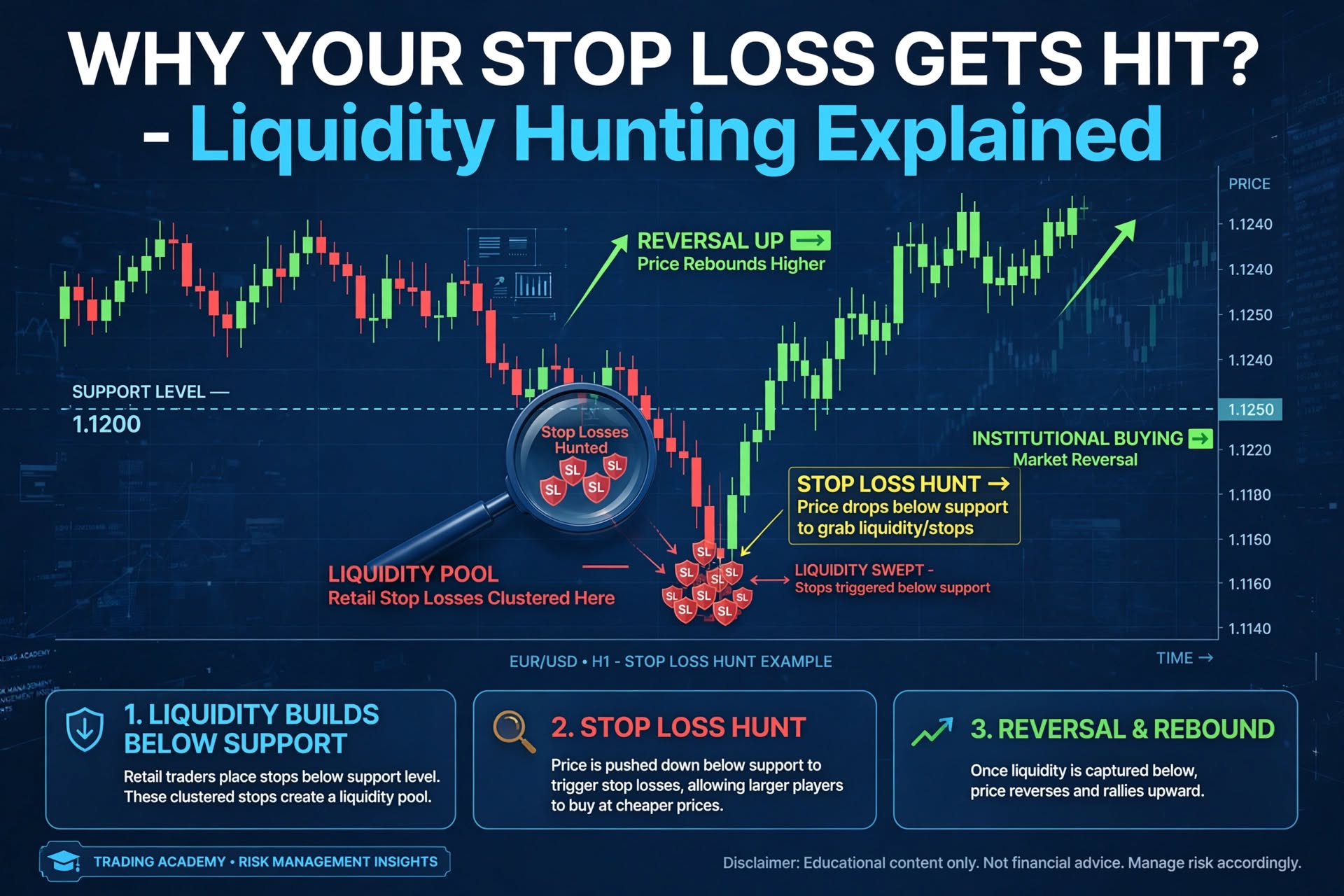
You buy Gold. You set your stop loss perfectly below support. Price goes down, hits your stop loss by $1, then immediately shoots up without you. You were right about the direction, but you still lost money.
This is not bad luck. This is Stop Loss Hunting – and it is caused by liquidity.
What is Liquidity in Trading?
Liquidity is where most stop losses are sitting. Think of the market like an ocean.
Big banks and institutions need a lot of water (liquidity) to enter big trades. They cannot enter where there is no water. Where is the most water? Just above and below key support and resistance levels, where all retail traders place their stop losses.
So what do they do? They push price to that level, take your stop loss as their liquidity, and then move the market in the real direction.
At Amej Trading, we teach this in Module 4: Market Structure & Technical Precision. Price doesn’t move randomly. It moves from liquidity to liquidity.
The 3 Places Where Your Stop Loss Gets Hunted
1. Above Double Tops / Below Double Bottoms
Everyone puts their stop just above the high. Smart money knows this. They push price above the high, grab liquidity, then reverse.
2. Equal Highs and Equal Lows
If you see 3 candles with the same high, that is a pool of liquidity. Price will almost always hunt it.
3. During High Impact News
During NFP, CPI, and FOMC, spreads widen and price spikes. This is the biggest stop hunt. This is why at Amej, we advise beginners to avoid trading the first 5 minutes of major news.
How to Avoid Getting Stop Hunted – 4 Rules From Amej Trading
Rule 1: Don’t Place Your Stop at the Obvious Level
If support is $4,260, don’t place your stop at $4,259. Place it at $4,245 where there is no obvious liquidity. Give it breathing space.
Rule 2: Use the 2% Risk Rule
Never risk more than 2% of your account on one trade. Even if you get hunted, you live to trade tomorrow. This is our #1 Capital Protection rule at Amej Trading.
Rule 3: Trade Confirmation, Not Prediction
Instead of buying at support, wait for price to hunt liquidity and come back. Let price sweep below support, then reclaim it. That reclaim is your entry. This is called a “Turtle Soup” entry – we teach it in iTrade.
Rule 4: Let Someone Else Watch The Hunt
This is why 10,000+ traders use our iCopy system. Our verified traders understand liquidity. They know when a stop hunt is happening and how to avoid it. You don’t need to stare at charts.
Conclusion: Stop Fighting Smart Money, Follow It
The market is not against you. It is just designed to move towards liquidity first. Once you understand this, you stop getting angry and start trading like a professional.
You cannot stop-hunting. But you can learn to use it to your advantage.
Want to Learn How We Trade Liquidity Live?
Our next Free Live Trading Session is this Saturday. We will show you on live charts how to spot liquidity pools before price hunts them.